
The final book in the Daevabad Trilogy
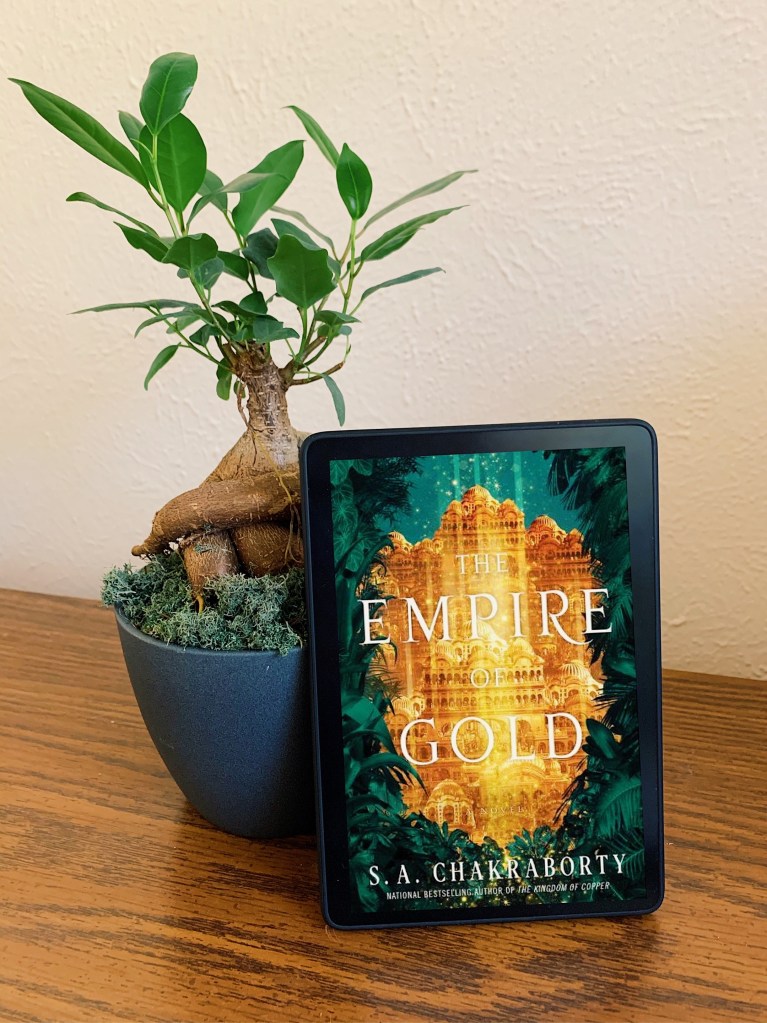
The Daevabad Trilogy is finally complete! The trilogy is three fantasy novels set in a fictional land in the Middle East, ruled by magic and politics. We have Nahri, who has grown up without magic in Cairo and Ali, who is second in line to the Daevabad throne, as our main characters, and we follow them on a journey to bring peace to the city of Daevabad without repeating the bloodshed of their parents.
Empire of Gold continues to follow Nahri, Ali, Dara, and Manizeh as they fight for power and deal with the fallout from Suleiman’s seal leaving Daevabad.
Overall, Empire of Gold was a wonderful ending to the trilogy. I rate the entire series between 4 and 4.5 stars, and recommend this to anyone who is interested in fantasy / magic and likes a good amount of world building and intrigue.
~Spoilers abound below~
Most of the loose ends were wrapped up, and I was satisfied with who was left in power at the end. However, it could have been 200 pages shorter. I did not care for Manizeh in the slightest and most of her and Dara’s chapters were spent reminiscing about past battles/relationships that didn’t seem to matter much to the current story line. Chop them out, and have our friendly croc Sobek explain to Nahri and Ali whatever we needed to know.
Manizeh is a power hungry witch throughout the whole book. Man, I hated her. She refused to entertain the opinions of others (Dara) and spent the majority of the book allying herself with the Ifrit and using sacrificial blood magic to coalesce her power. No, thank you! My hatred of her probably contributed to me wanting to cut out those parts of the book, but I stand by that.
Another point of contention was how long it took for Nahri and Ali to finally admit their feelings to each other. I may be missing a nuance of Middle Eastern culture in these comments, so please take them with a grain of salt. In my opinion, they were in the middle of a war and should have taken any grab at happiness they could get. Despite Muntadhir’s continued existence, but, also, they thought he was dead for a majority of the book and still didn’t get together. I wanted them to at least have a bigger moment of happiness and that should have happened when they were recovering in Cairo at the beginning of the book. It was implied that they were together, in their own way, at the end, but I would have loved to seen at least one scene of them mutually declaring their love for each other so I could drool over it.
Now, let’s talk about all the different kinds of magic in this world. There’s marid magic, blood magic (same as the ifrits?), daeva magic, and Nahid / healing magic. I have read all three of these books and I still am not clear on what the divisions are. I really wish Chakraborty explained all of this better. Like I said earlier, our friendly croc Sobek would have been the perfect vehicle for this kind of reveal. Although, if she’s setting up the universe like this so that she can come back and write more books later, I wouldn’t be mad.
One of the main things that I loved about this book was all of the demonstrations of the different kinds of magic and the fleshing out of the world around Nahri and Ali.
They got to go back to Egypt, which explained the whole different worlds / veils concept. Ali met his marid ancestors, who explained a good amount of the start of humanity’s relationship with magic, which was super cool. And finally Dara was able to tell us some tales about his past when he was a slave, which brought a lot more sense to the racial/class divisions in Daeavabad. Well done! It sucked me even further into this world. I could read about Ali figuring out his marid powers and Nahri healing him for another book, for sure.
 SJP Books